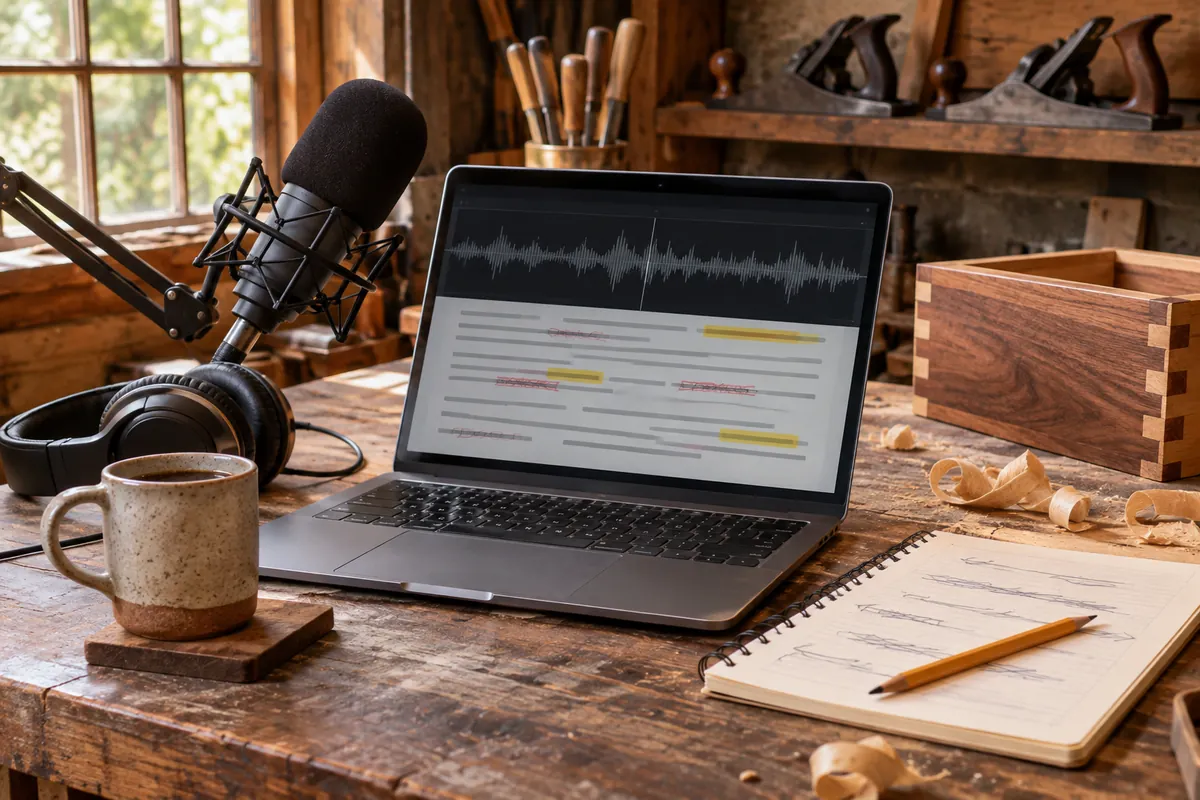
The greatest risk in reviewing a machine-generated transcript is not always an obvious jumble of words. It may be a persuasive, grammatically correct sentence that the guest never said. That is why recognition output needs a listening pass focused on meaning and identity, as well as a separate review for readability.
Treat the draft as a working copy
Automatic recognition can produce convincing sentences that differ from the audio. Even readable text needs verification when it will be published as someone's words.
Keep the original audio alongside the draft and preserve the raw transcription separately. There is an advantage to doing this before investing more time in the rest of the work. It exposes assumptions that can otherwise survive until the final stage, where they are more expensive or awkward to correct. Allow enough time to examine the result in the same circumstances where it will actually be used. Identify the parts of the programme where recognition is likely to be unreliable. Keep the first version nearby so that a later change can be judged against it rather than against an imperfect memory.
Check names and unusual terms
Trade vocabulary, places and unfamiliar names may be replaced by common words that sound similar. Repeating the same wrong spelling throughout the transcript does not make it accurate.
Do the small preliminary exercise before getting absorbed in the larger task. Create a list of recurring names and terms drawn from the recording and approved notes. Think about what might make it fail outside this particular example, such as a change in the available time, the material or the person doing the work. Listen to several uses before settling on a spelling. Where the method is promising but the result remains inconsistent, simplify the arrangement or examine the source of the discrepancy. A method you understand well is generally easier to adapt than one that happens to work once.
Inspect speaker changes
A recognized passage may assign words to the wrong person or merge a response with the previous speaker's question. This changes who appears to hold an opinion.
Pay careful attention to the reference used for the comparison. Listen especially at short responses, interruptions and changes of subject. The original condition gives this exercise meaning; if it is lost, the result can become difficult to interpret. Work with a temporary copy or a small example wherever that is appropriate. Move text only when the actual voices support the correction. Keep track of the differences that truly matter and distinguish them from incidental details. The point is to make a reliable choice, not to collect as many observations as possible without knowing how they affect the finished work.
For more on a nearby subject, read How to Transcribe a Podcast by Hand.
Restore missing material
Quiet words and rapid speech sometimes disappear entirely from a draft. Missing a negative or a qualification can reverse a statement's meaning.
Test the proposed arrangement under conditions that are close to the finished task. Compare an uncertain passage with the corresponding audio instead of relying on grammar alone. This is where an overlooked assumption often becomes visible. A satisfactory result with a very short or easy example does not necessarily reveal what happens when there are interruptions, changes of pace or several related details. Make sure the corrected sentence preserves the original intention. If you discover a problem, note where it begins rather than treating everything around it as a failure. A local correction can preserve useful parts of the original approach.
Resolve punctuation thoughtfully
A machine-generated comma or question mark may imply emphasis that was absent in the recording. Use punctuation to clarify syntax without turning spoken language into unfamiliar prose.
Read the text while listening to the speaker's cadence. One advantage of doing this carefully is that a later decision can be based on more than the impression left by the most recent attempt. Keep a concise record that identifies what was changed and what was observed. Make changes that preserve meaning and distinguish real questions from statements. It is particularly important not to attribute an improvement to the wrong cause when several things happened together. Try a controlled comparison if the explanation is uncertain; a short sensible check is usually less work than correcting a mistaken assumption throughout the project.
Remove filler according to a policy
A strict transcript and a lightly edited transcript have different purposes. Unannounced changes can misrepresent the character of the speech.
A useful rule at this stage is to protect the part of the work that has already been established. Define how to handle false starts, repeated words and long pauses. This gives you a way to introduce changes without undoing earlier progress. Avoid editing away uncertainty or changing the substance of a response. Keep details that explain the relationship between the current choice and preceding decisions, especially when a result depends on an earlier version. Think about how you would resolve an unexpected problem if it appeared the following day. A record of the relevant circumstances often saves repeated work.
For a related part of the process, see Organizing a Small Podcast Content Library.
Verify timestamps after changes
A draft generated from another edit may carry time marks that no longer match the published audio. Several small cuts can accumulate into a significant offset.
Check time marks near the beginning, middle and end of the final file. Consider how this result will appear to someone who did not take part in producing it. They will not have the same knowledge of discarded attempts, temporary adjustments and other circumstances. Correct the entire sequence when the mismatch is systematic. A brief independent check can reveal a problem that has become familiar enough for you to overlook. If the check suggests a substantial change, preserve the version you already have and make the correction deliberately. Avoid creating unrelated revisions while trying to resolve one recognizable difficulty.
Perform a final reading pass
A transcript can be accurate in short fragments yet difficult to read as continuous conversation. Speaker labels and paragraphing deserve a separate review.
Before moving on, establish whether the method can be repeated without reconstructing every decision. Read the final copy without simultaneous audio, then revisit unresolved passages. Make the remaining checks using the actual output rather than relying entirely on the appearance of the working version. Keep a transparent indication of anything that remains genuinely inaudible. If the work needs a further change, keep the reference that shows why. Otherwise, write down the useful choices and put them into practice during the next comparable task. This turns the effort of the first experiment into material that continues to be useful.
Before moving on
A polished transcript is useful when it still belongs to the recording that produced it. Preserve the verified words, mark genuine gaps and keep the source version close at hand.