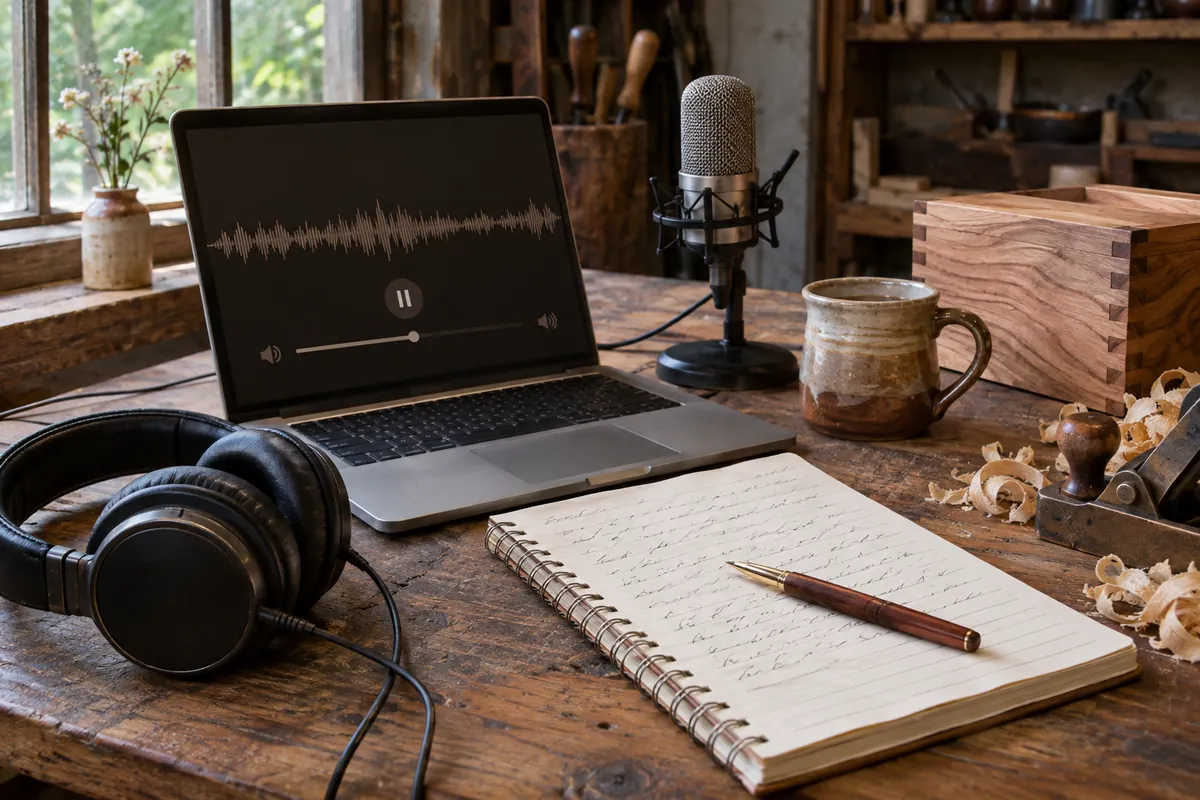
A conversation that is easy to follow in headphones becomes more complicated when you begin putting it into writing. People hesitate, speak over one another and refer to earlier remarks without repeating the subject. Manual transcription requires many small decisions about how these sounds should appear on a page. The recording, rather than the smoothness of the emerging text, remains the reference.
Decide how literal the transcript will be
A research transcript may preserve every hesitation, whereas an ordinary reading transcript can often omit repeated filler without changing meaning. Establish the convention before typing.
It is worth deciding what a satisfactory result would look like before proceeding. Write a short note describing what will be retained and how inaudible material will be marked. A clear expectation makes it easier to recognize when a small alteration has done enough and another is unnecessary. Try not to confuse a conspicuous change with an actual improvement. Apply the same convention to both host and guest. If the outcome is difficult to assess, repeat the exercise with a simpler example and keep the two versions separate. The comparison is useful even when neither version is ready for final use.
Work from the final recording
Transcribing an earlier version makes it difficult to match the published audio. Edits to the beginning or middle can invalidate all subsequent timestamps.
Do the small preliminary exercise before getting absorbed in the larger task. Identify the actual final file before beginning and preserve its duration. Think about what might make it fail outside this particular example, such as a change in the available time, the material or the person doing the work. Open the recording independently of the editing project. Where the method is promising but the result remains inconsistent, simplify the arrangement or examine the source of the discrepancy. A method you understand well is generally easier to adapt than one that happens to work once.
Divide the recording into sections
Listening to a complete programme while typing can be tiring. Small segments provide clear stopping points without making a long conversation feel fragmented.
Work through a few minutes at a time and save at natural changes of topic. Consider what would make someone else interpret this result differently. Is something obvious to you only because you know what happened just before, or because you have spent time with the original material? Look briefly at the problem from the perspective of someone encountering it for the first time. Keep the last completed time visible so that no part is missed. Add clarification if necessary, but avoid inventing a complication where none exists. The most helpful change is the one that addresses a specific difficulty without adding another.
For more on a nearby subject, read Cleaning Up an Automatic Podcast Transcript.
Use speaker labels consistently
A clear speaker label helps readers follow changes of voice, especially in an extended conversation. Inconsistent naming makes the transcript unnecessarily difficult to navigate.
Test the proposed arrangement under conditions that are close to the finished task. Assign labels based on the speakers' agreed names or roles. This is where an overlooked assumption often becomes visible. A satisfactory result with a very short or easy example does not necessarily reveal what happens when there are interruptions, changes of pace or several related details. Check that dialogue remains understandable without the original sound. If you discover a problem, note where it begins rather than treating everything around it as a failure. A local correction can preserve useful parts of the original approach.
Mark words you cannot establish
An uncertain guess can turn an unclear phrase into a false quotation. It is better to mark the gap than invent language that sounds plausible.
Before extending this change to everything else, see how it behaves in a small controlled example. Replay the uncertain section at a comfortable speed and consult nearby context. When possible, choose material that contains both ordinary features and the difficulty you are trying to address. This gives a more balanced impression of the result than selecting only the worst portion. If uncertainty remains, mark the location and return to it during review. A correction that improves one area but makes the normal material harder to use should be reconsidered. Adjust the scope instead of applying a broad solution merely for consistency.
Handle punctuation as speech
Spoken sentences do not always end where written ones would. Punctuation can make an utterance readable but should not silently alter its intent.
Read a passage aloud after adding punctuation. A recurring difficulty at this stage can be a sign that an earlier part of the process was not arranged conveniently. Instead of repeatedly compensating for the same fault, look back at what led to it. Check whether the pauses and relationships between clauses still reflect the recording. A small adjustment near the source may remove the need for an expensive correction every time. Preserve the current material until the revised approach has been tested. If the new version is worse, return to the earlier one and retain what you learned from the example.
There is a closer look at a related question in Organizing a Small Podcast Content Library.
Review against the recording
A typo in an everyday word is usually easy to fix; a wrong number, name or technical term can significantly distort the transcript. Give such details special attention.
Perform a second listening pass over marked uncertainty and important factual details. Now compare the proposed solution with the actual needs of the finished work. A technically interesting alteration is not necessarily an editorial or practical improvement. Correct only what the audio or a legitimate clarification supports. Evaluate the complete result, including the portions that were not changed, to make sure the choice did not create an unexpected difference elsewhere. If everything behaves as intended, stop adjusting it. The ability to decide that something is finished is an important part of a dependable independent workflow.
Prepare the reader-facing copy
Long uninterrupted exchanges are difficult to scan. Speaker labels, thoughtful paragraph breaks and a few time marks improve usability.
End by checking the deliverable against its intended use. Open the transcript as an ordinary web page and read several sections. Allow for the fact that a small difference may be unimportant in one context and consequential in another. A reader should be able to locate a voice and return to the corresponding audio. A final review should establish what is actually known about the result and identify anything that needs a separate investigation. Do not assume that a successful example proves the same approach works for every possible situation. The evidence from this particular piece of work is sufficient for a sensible next decision.
Putting the method into practice
Save the verified transcript with a note identifying the audio version and the transcription convention. If a phrase is still uncertain, leave a clear indication of that uncertainty for a later reviewer.