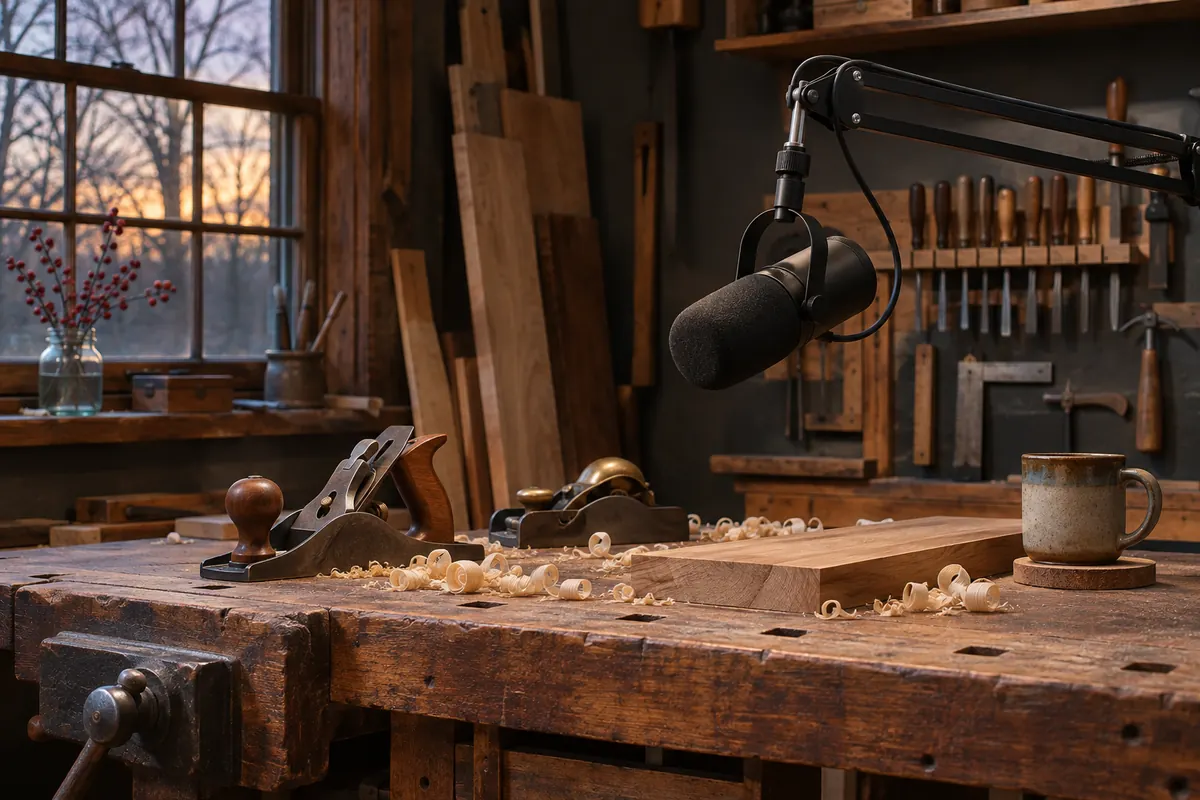
The familiar sounds of a workshop carry a sense of place, but they can also make a conversation difficult to hear. A bare wall returns a voice differently from a furnished room, and a fan that seems insignificant during practical work may dominate a quiet recording. Treat speech and atmosphere as two distinct parts of the production. Neither needs to interfere with safe work in the shop.
Choose the quiet window
A workshop may be silent at one hour and full of fans, neighbours or delivery noise at another. Listen before choosing the recording slot.
It is worth deciding what a satisfactory result would look like before proceeding. Make short tests in the morning and afternoon with the usual doors and windows in position. A clear expectation makes it easier to recognize when a small alteration has done enough and another is unnecessary. Try not to confuse a conspicuous change with an actual improvement. Note which noises are steady and which arrive unpredictably. If the outcome is difficult to assess, repeat the exercise with a simpler example and keep the two versions separate. The comparison is useful even when neither version is ready for final use.
Record away from active work
Tools, moving machinery and conversation do not mix well by default. Finish noisy work before recording and do not operate equipment while handling audio gear.
Do the small preliminary exercise before getting absorbed in the larger task. Set the recording corner apart from active work areas. Think about what might make it fail outside this particular example, such as a change in the available time, the material or the person doing the work. Confirm that the arrangement leaves clear movement paths and no tangled cables in working space. Where the method is promising but the result remains inconsistent, simplify the arrangement or examine the source of the discrepancy. A method you understand well is generally easier to adapt than one that happens to work once.
Move closer to the speaker
In a reflective room, reducing the distance to the microphone increases the direct voice relative to the space. Too close can introduce breathing and excessive bass.
Pay careful attention to the reference used for the comparison. Try two positions while keeping the speaker comfortable. The original condition gives this exercise meaning; if it is lost, the result can become difficult to interpret. Work with a temporary copy or a small example wherever that is appropriate. Listen for clear consonants and the absence of an exaggerated low-end sound. Keep track of the differences that truly matter and distinguish them from incidental details. The point is to make a reliable choice, not to collect as many observations as possible without knowing how they affect the finished work.
For more on a nearby subject, read Setting Recording Levels Without Clipping.
Soften nearby surfaces
Hard benches and parallel walls return reflections into the microphone. Useful treatment can be temporary and must not interfere with workshop ventilation or safe access.
Give yourself a little room to adjust without losing sight of the purpose of the exercise. Test a heavy cloth on an unused surface near the recording corner. An arrangement that is almost right may need a small practical change rather than a full redesign. Compare pauses and the apparent distance of the speakers. If possible, compare the result at a later stage, when you can assess it in relation to the other work. Keep the parts that already perform well. Repeated changes to a satisfactory detail consume time and may introduce problems that were not present originally.
Separate atmosphere from dialogue
A short recording of the workshop ambience can establish setting without masking a guest's words throughout the programme. Keep it separate from the main voice track.
Record a brief atmosphere sample when it is safe and no machinery is being handled. There are often several plausible ways to approach the same issue. The useful test is one that distinguishes their practical effects rather than comparing an ideal description of each method. Ask whether the sound establishes place without covering essential speech. Keep the comparison honest by using similar starting conditions and avoiding a different standard for the favoured option. If the difference is too small to matter, consider keeping the simpler method for now. More demanding situations can provide additional evidence when they arise.
Plan for interruptions
A passing truck or abrupt noise can make a sentence unusable. A calm pause and a clean restart often sound more natural than aggressive editing.
Agree on a signal for a short pause and resume the thought from a complete phrase. A recurring difficulty at this stage can be a sign that an earlier part of the process was not arranged conveniently. Instead of repeatedly compensating for the same fault, look back at what led to it. Mark the restarted sentence so that the useful take is easy to identify. A small adjustment near the source may remove the need for an expensive correction every time. Preserve the current material until the revised approach has been tested. If the new version is worse, return to the earlier one and retain what you learned from the example.
For a related part of the process, see Exporting and Archiving a Finished Podcast.
Protect the recording equipment
Dust and accidental contact are ordinary risks in a shop. Audio equipment needs a clean, stable position away from debris and ongoing operations.
Set up a clean table and route cables outside circulation areas. Now compare the proposed solution with the actual needs of the finished work. A technically interesting alteration is not necessarily an editorial or practical improvement. Check that moving from the bench to the chair does not disturb the recording. Evaluate the complete result, including the portions that were not changed, to make sure the choice did not create an unexpected difference elsewhere. If everything behaves as intended, stop adjusting it. The ability to decide that something is finished is an important part of a dependable independent workflow.
Listen away from the workshop
Listeners may use quiet headphones, making faults less obvious while recording amid ambient noise. A separate check reveals how much surrounding sound remained.
End by checking the deliverable against its intended use. Review a raw passage in a quiet room and note the most intrusive sounds. Allow for the fact that a small difference may be unimportant in one context and consequential in another. Change the recording position or schedule before trying heavy noise reduction. A final review should establish what is actually known about the result and identify anything that needs a separate investigation. Do not assume that a successful example proves the same approach works for every possible situation. The evidence from this particular piece of work is sufficient for a sensible next decision.
Putting the method into practice
The best improvement may be a change of location or timing. Carry a clean sample of the resulting speech to the editing desk and keep the surrounding sounds separate if they are needed for the story.