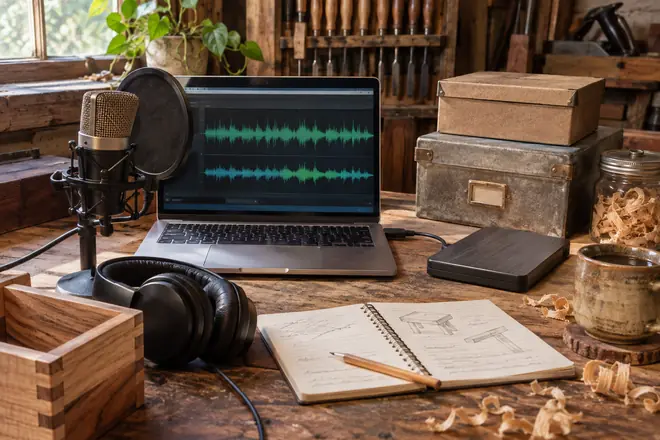

A first edit often exposes the difference between the experience of having a conversation and the experience of listening to it later. Some repetition that passed unnoticed at the table may be tiring in headphones. A pause that seemed awkward at the time may carry a significant change of thought. The useful work of editing lies in distinguishing the two.
Listen for the story before cutting
A rough interview often contains threads that only become clear near the end. An early detailed edit can waste time polishing sections that will later be removed.
Begin with something you can observe directly. Listen through the whole source and mark topic changes without making detailed cuts. Keep the first attempt deliberately basic; otherwise it becomes difficult to separate a useful change from the effects of everything else that has changed at the same time. Make a short note of the starting conditions and retain it for the next attempt. Create a simple map of the main ideas, supporting examples and digressions. If this is not apparent, reconsider the starting point instead of adding complexity. A workable baseline is often more informative than an elaborate arrangement made before the practical problem is understood.
Preserve useful hesitation
A moment of thought can communicate uncertainty, concentration or emotion. Removing every pause may make a speaker sound hurried or unnaturally certain.
Distinguish repeated filler that obscures meaning from pauses that carry meaning. Use enough material to expose the ordinary variations you expect to encounter. A few seconds or a single particularly easy example can conceal a weakness that becomes obvious when attention moves elsewhere. When a change seems helpful, consider whether the same approach remains manageable under normal conditions. Compare a highly tightened version with a more natural version. A method that requires constant correction is unlikely to be a dependable part of a recurring routine. Prefer the arrangement that leaves you free to concentrate on the actual work.
Remove repeated material carefully
A second explanation may contradict or clarify the first. Cutting both down to a single statement can accidentally change what the speaker intended.
Identify each repetition and keep the version that includes the necessary context. Consider what would make someone else interpret this result differently. Is something obvious to you only because you know what happened just before, or because you have spent time with the original material? Look briefly at the problem from the perspective of someone encountering it for the first time. Check adjacent sentences for references that no longer make sense. Add clarification if necessary, but avoid inventing a complication where none exists. The most helpful change is the one that addresses a specific difficulty without adding another.
For more on a nearby subject, read Exporting and Archiving a Finished Podcast.
Cut at natural boundaries
A cut that joins unrelated fragments can create an audible jump in pitch, background noise or grammar. Complete clauses often provide better joining points.
At this point, a representative example is more helpful than a vague impression about the work. Listen a few seconds on either side of each proposed cut. Save any useful record of the exercise, including the original version where appropriate. Compare the results in their ordinary context instead of viewing each in isolation. Adjust the boundary until the sentence sounds continuous. If a small alteration causes a new problem nearby, consider reversing it and trying a more restrained approach. A careful comparison can be completed quickly once the question has been narrowed to something specific.
Use room sound for transitions
Silence in a digital timeline can be more conspicuous than the quiet sound of the original room. A short matching ambience may smooth a transition.
Before extending this change to everything else, see how it behaves in a small controlled example. Collect a little steady room sound from an unspoken part of the recording. When possible, choose material that contains both ordinary features and the difficulty you are trying to address. This gives a more balanced impression of the result than selecting only the worst portion. Use only as much as necessary, then listen on headphones. A correction that improves one area but makes the normal material harder to use should be reconsidered. Adjust the scope instead of applying a broad solution merely for consistency.
Check speaker relationships
When one speaker's response is moved earlier, it may appear to answer a different question. Editorial clarity cannot come at the expense of the meaning of the conversation.
Try to separate the parts that require precise judgment from those that can reasonably vary. Keep the source order unless there is a good editorial reason to reorganize it. This keeps attention available for the places where a small mistake has a significant consequence. Verify that each response still answers the question a listener hears. If a detail does not affect the intended result but takes an unreasonable amount of time to refine, reconsider whether it deserves further attention. A reliable outcome does not require every intermediate choice to be identical. It does require a clear reason for the decisions that matter.
Further reading in the journal: Recording a Two-Person Conversation.
Work from a clean source
Repeated exports and destructive edits can limit later choices. Keep original recordings and perform editorial work in a separate session.
Work through this part using a genuine example rather than a perfect demonstration. Duplicate the session before making major structural changes. Consider whether the result remains clear if you have not looked at the surrounding notes for a while. Compare the updated cut with the previous version when uncertain. Anything requiring an explanation that exists only in your memory is worth clarifying before moving on. This does not call for a lengthy record of every minor action. Include the information needed to recreate important choices or explain why a result differs from what was originally expected.

Review the complete episode
A polished collection of sections may still feel uneven when heard from beginning to end. Listen once without stopping for small repairs.
Record notes with times for substantial problems, then address them in a separate pass. Review the result as a whole instead of concentrating only on the most recent adjustment. This is a useful moment to distinguish essential checks from personal preferences that have little effect on the finished material. The final episode should sound like a considered conversation, not a series of fragments. If an issue remains, describe it precisely enough to guide a later attempt. Keeping a concise record of the unresolved problem can be more helpful than continuing to make small changes without a clear expectation of what will improve.
Before moving on
Return to the unedited recording if a passage no longer sounds like the same conversation. A shorter programme is worth having only when the people, sequence and meaning remain recognizable.